

Is training with incline only meant for mountain hikers, or is it also a good idea for your daily movement? Whether you're walking to improve your fitness or training for a faster 10K: the incline function is your hidden power. In this article, we dive into the science behind incline training and help you discover if training at an elevation is the right choice for you.
What are the benefits of walking with incline?
Walking on a flat surface is a perfect foundation, but by raising the treadmill just a few degrees, you completely change the way your body moves. Your workouts deliver more results in the same amount of time.
- Higher calorie burn without running: walking on an incline significantly increases your heart rate. Research from the University of Florida shows that at an incline of just 5%, you burn almost 50% more calories than on a flat road at the same speed.
- Less impact, more results: for people with sensitive knees, an incline is a lifesaver. You increase the intensity of your workout without the high-impact shock of running.
- Stronger legs and glutes: with incline, your hamstrings, calves, and glutes have to work much harder to push your body upward. It is essentially strength training and cardio in one.
Want to start walking with incline? The 12-3-30 method is a very good way to build up your incline training.
What are the benefits of running with incline?
For the runners among us, an incline isn't just an extra - it’s an essential part of a balanced schedule. If you want to train variedly and efficiently, incline training is a vital addition to the miles you clock outdoors.
- Simulating the outdoors: indoors, there is no wind resistance. By setting your treadmill to a standard 1% to 1.5% incline, you simulate the physical effort of running outside.
- Improved running technique: running on an incline forces you to land on your forefoot or midfoot and lift your knees higher. This improves your natural running form and makes you a more efficient runner on flat terrain.
- Hill sprints for speed: short, explosive sprints on an incline increase your 'stroke volume' (the amount of blood your heart pumps per beat). This directly translates to a faster pace during your races.
When should you avoid incline training?
Although an incline offers many benefits, there are moments when it's better to keep the treadmill flat:
- During recovery training: after an intense effort, you want to keep your heart rate low and allow blood to flow gently through your muscles. An incline adds unnecessary extra strain.
- With specific injuries: do you suffer from Achilles tendon issues or active back pain? A steep incline can increase tension in these areas. In such cases, always consult a specialist first.
- Focus on pure speed: if you are training at your absolute top speed (sprints), a flat surface is safer for perfecting your coordination and cadence.
Hiking or running through the hills. At home.
Is it a good idea to train with an incline? For 90% of people, the answer is: yes, as an addition. It makes you stronger, improves your fitness faster, and keeps your training challenging. Mix it up: do one session per week specifically on an incline (for example, a 'power walk' or hill intervals) and use the other days for recovery and speed on a flat track.
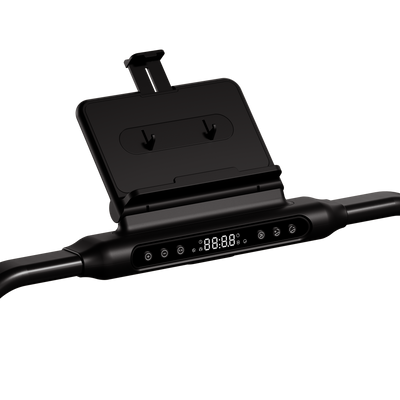
Moov lowers the threshold for incline training at home. While many treadmills rely on manual adjustments, the Moov Walk Plus and Run Plus feature a strong and silent brushless motor that adjusts the incline fully automatically up to 15%. With a single touch, you can shift your intensity without breaking your flow. This is the ultimate way to achieve maximum calorie burn and muscle activation on a compact machine that never compromises on power.


