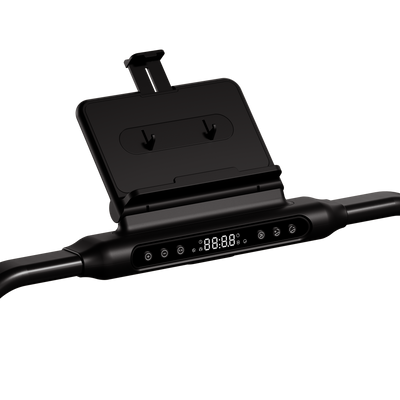



Some days call for more variation than one steady pace. Interval training alternates more active blocks with calm recovery. You can do that while walking, jogging or running. HIIT is the more intense version, and it does not suit every moment or every level.
In short
- Interval training alternates faster and calmer blocks.
- Not every interval session needs to be an all-out HIIT workout.
- Begin with walking or easy jogging and build one variable at a time.
- A warm-up and cool-down belong in the session.
- Professional advice matters when you have medical symptoms, are recovering or have been inactive for a long time.
What is interval training or HIIT on a treadmill?
During interval training, you alternate a pace that clearly requires effort with a calmer pace. You will usually keep walking during recovery. Your breathing settles, your posture resets and the next active block follows. For jogging and running intervals, the Moov Run is designed with extra room for your stride.
HIIT stands for high-intensity interval training. The active blocks are genuinely demanding, which makes HIIT a poor first step for many beginners. Walking intervals use the same structure at a more approachable level.
The benefits
- Changes in pace bring variety to a shorter session.
- You can adjust the load through speed, duration or incline.
- Recovery blocks let you repeat several more active efforts.
- Interval training can support fitness when the load and frequency suit you.
- You become better at recognising a brisk, hard or recovering pace.
Why interval training can fit a full day
A busy day may leave twenty or thirty minutes. A simple structure helps. Five minutes to warm up. A few blocks. A calm finish. You do not have to improvise, and you do not have to beat the previous session.
The value is not only in intensity. A walking interval can vary your heart rate and make a familiar session feel different. Choose the version you could return to tomorrow.
More intensity is not automatically better
Claims that HIIT burns a fixed percentage more fat than steady cardio are too absolute. Outcomes vary by person, protocol and total training load. Choose the training style that fits your health, experience and week.
How do you do an interval session?
- Warm up for 5 to 10 minutes with calm walking or easy jogging.
- Choose an active block that clearly feels harder while your posture remains stable.
- Lower the pace for recovery and allow your breathing to settle.
- Repeat the active and recovery blocks according to your plan.
- Finish with 5 minutes of calm walking.
Interval training plans
|
Steps |
Phase |
Duration |
Pace |
|
1 |
Warm-up |
5 min |
Calm walking |
|
2 |
Active block |
1 min |
Brisk walking |
|
3 |
Recovery |
2 min |
Calm walking |
|
4 |
Repeat |
5 times |
Active block + recovery |
Intermediate plan – walking and jogging
|
Steps |
Phase |
Duration |
Pace |
|
1 |
Warm-up |
7 min |
Walking to easy jogging |
|
2 |
Active block |
1 min |
Faster jogging |
|
3 |
Recovery |
90 sec |
Walking or very easy jogging |
|
4 |
Repeat |
6 times |
Active block + recovery |
Tips for a good interval session
- Choose one aim in advance: longer running time, a slightly faster pace or more repetitions.
- Use perceived effort as well as the speed shown on the display.
- Let at least one calm day follow a hard session.
- Add incline only when flat intervals feel stable.
- To combine pace and incline, the Moov Walk Plus and Moov Run Plus add automatic variation.
- Do not train at high speed while working, calling or watching a screen.
- A calm session after a break is not a step backwards. It is how you find your rhythm again.


